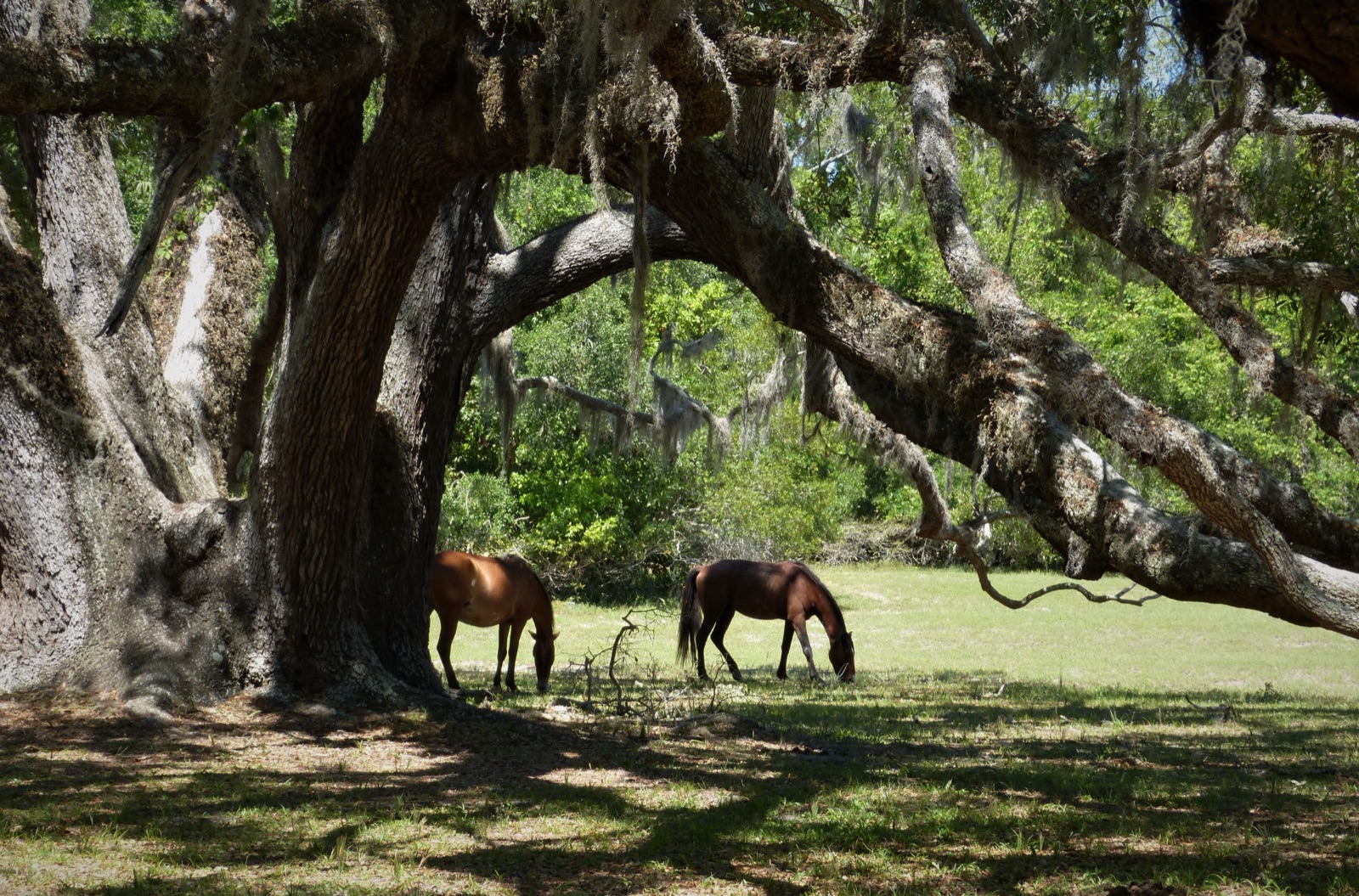
Photo: gailhampshire / Wikimedia Commons (CC BY 2.0)
Cumberland Island, Where the Horses Run Wild
There is only one way to reach Cumberland Island, and that is by boat.
The ferry leaves from the little town of St. Marys, on the southern edge of Georgia, and the crossing is part of the point. By the time the mainland slips away and the island’s tree line rises ahead, you have already begun to leave the ordinary world behind. There are no bridges here, no shops, no concessions. The number of visitors allowed ashore each day is strictly limited, and once you land, the silence is the first thing you notice.
At nearly eighteen miles long and more than thirty-six thousand acres, Cumberland is the largest of Georgia’s barrier islands, and almost all of it is protected as a National Seashore. The landscape shifts as you move through it: towering dunes, maritime forests of wind-bent live oak, salt marsh stretching toward the horizon, and one of the longest undeveloped beaches left on the Atlantic coast. You can walk for an hour and meet no one.
But it is the horses that people come to see. A band of feral horses roams the island freely, grazing on the lawns around the old Dungeness ruins, moving along the dunes, sometimes standing right at the edge of the surf in the early light. They number somewhere around a hundred and fifty to two hundred, and they are unlike any other horses on the Atlantic seaboard, completely unmanaged, given no food, no veterinary care, no intervention of any kind. They live and die entirely on the island’s terms. To come upon them without warning, framed against the sea, is to understand why the island has worked its way so deeply into the Southern imagination.
The horses are also the island’s quiet controversy, and honesty requires mentioning it. They are not native, and their grazing and traffic take a toll on the dunes and wetlands that so many native species depend on. There is a real and ongoing debate about whether and how they should be managed. It is the kind of tension that runs through many beloved wild places, the gap between what moves us and what the land can bear.
History layers the island as thickly as the moss hangs from its oaks. Indigenous Timucua people, Spanish missionaries, enslaved laborers, and, in the Gilded Age, the Carnegie family, whose grand Dungeness mansion once stood near the south end. The mansion burned in 1959 and its ruins remain, a roofless brick skeleton with horses often grazing in its shadow. A small white church still standing on the north end, the First African Baptist Church, drew the wider world’s attention in 1996 as the site of the very private wedding of John F. Kennedy Jr. and Carolyn Bessette.
Before you go
A day on Cumberland asks a little planning. The Cumberland Island National Seashore ferry runs from St. Marys and sells out in busy months, so reserve ahead through the park service. There are no stores on the island, so carry in all your own food and water and carry out your trash. Spring and fall bring the most comfortable weather and the fewest bugs; summer is hot and the biting insects are serious, so pack repellent. Most day-trippers reach the Dungeness ruins and the nearest horses on foot from the Dungeness dock, while the Plum Orchard mansion and the wilder north end are better reached by bike. If you want to stay over, the island has a campground at Sea Camp, and the historic Greyfield Inn occupies a former Carnegie home.
That bit of friction is exactly what has kept the island wild. Walk the beach at dawn, before the day’s ferry arrives, and you may have miles of sand to yourself, a few horses grazing in the dunes, and dolphins working the channel as the tide turns. That hour is the whole reason to come.