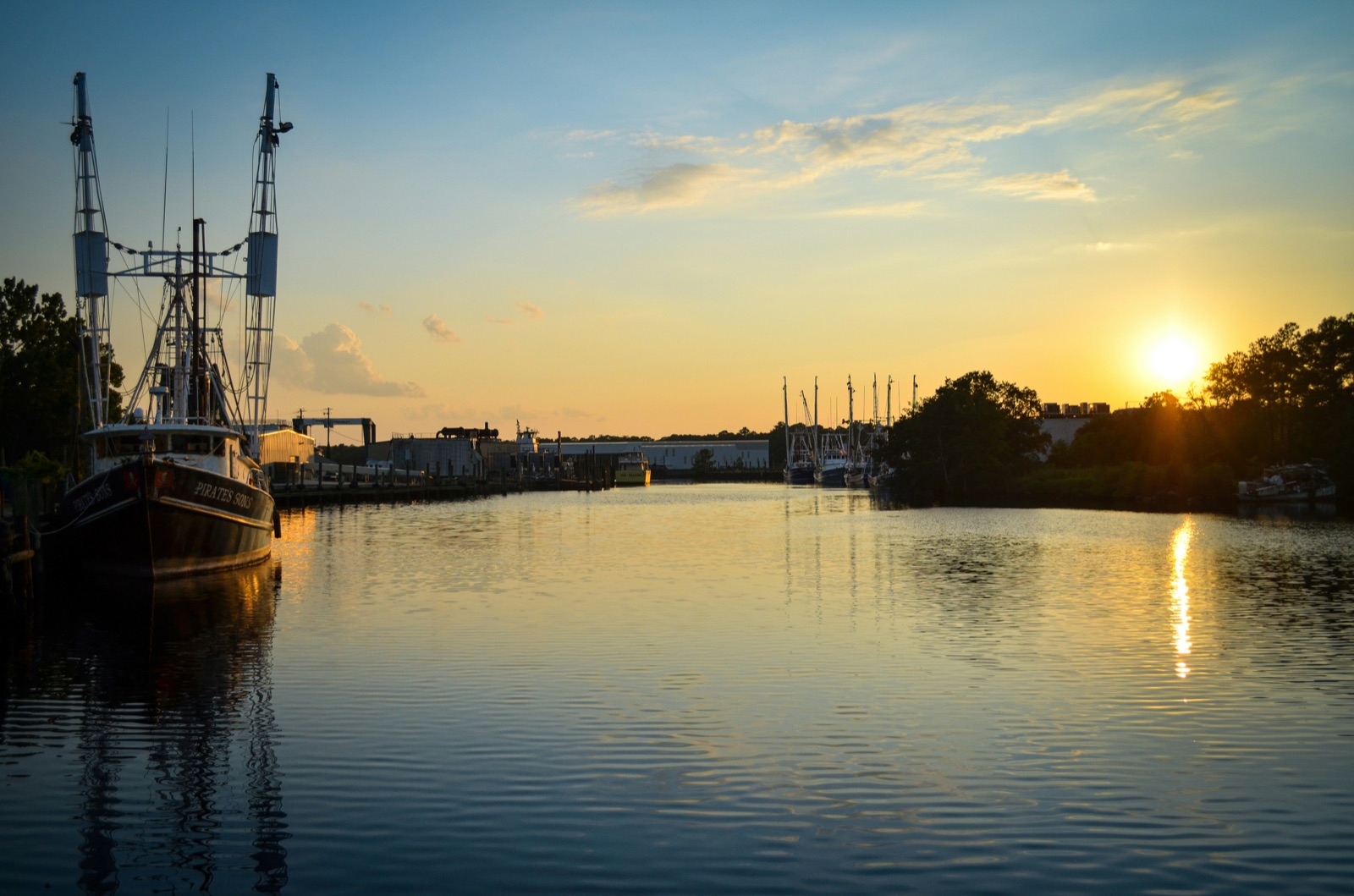
Photo: Cody Eason / Unsplash
The Boatbuilders of Bayou La Batre
Drive about twenty miles southwest of Mobile, past the strip malls and the pine flats, and the land gives out into marsh and water. At the end of the road is Bayou La Batre, a town of roughly two thousand people wrapped around a working canal. Pronounced by locals as “By-luh-bat-tree,” it has been here a long time. A French-born settler named Joseph Bosarge received a Spanish land grant on the bayou in 1786, making this the first permanent settlement on the south Mobile County mainland.
For most of its history the town has lived off the water, and an old saying captures what that meant in the lean years: you could hear anything in Bayou La Batre except money rattling and meat frying. The four seasons here were not spring and summer and fall and winter. They were shrimp, crab, oyster, and fish. And because the people fished, the people built boats.
For a stretch of a few decades, this small Alabama town was widely regarded as the busiest builder of shrimp trawlers in the world.
More than a boat a day
The shift began in the late 1940s, when the old wooden hulls started giving way to steel. It was the most dramatic change the town had seen, and it arrived just as Gulf shrimping was entering a boom. Demand for boats exploded, and Bayou La Batre answered it. From the 1970s into the early 1990s, the shipyards lining the canal turned out, on some accounts, more than a trawler a day. A dozen yards operated at once. People came from all over the coast, and beyond it, to have a boat built here.
Steiner Shipyard became the best-known of them. At its height it built more than a hundred and seventy-five shrimp trawlers for a single customer, the Tampa-based Sahlman Seafoods. The work was specialized and hard, the kind of knowledge that lives in a place rather than a book: how to loft a hull, how a Gulf trawler should sit in the water, how to make a boat that would run true with its outriggers down and its nets dragging.
Drive out Shell Belt Road today and the evidence is still there on both sides, the processing houses and the shipyards, the trawlers tied up along weathered piers with their tall outriggers and their booms, pelicans resting on the pilings between them. When the drawbridge over the main road goes up, it is to let a shrimp boat pass.
When the work changed
The trawler boom did not last, and Bayou La Batre has spent the years since doing what it has always done, which is adapt. Overbuilding, rising fuel costs, and a flood of cheap imported shrimp pulled the bottom out of the trawler business in the late 1990s. The yards that survived did it by diversifying. Steiner turned its operation toward fast repair work, hauling all manner of vessels out of the water on a marine travel lift and getting them back to work, sometimes within hours, filling a void no one else on the Alabama coast was covering. Other yards moved into building oil-supply boats, work boats, barges, tugs, and crew boats for customers around the world.
The town’s skill with a hull occasionally found stranger work. When Walt Disney Studios needed a pirate ship for the sequels to “Pirates of the Caribbean,” it was the Steiner yard in Bayou La Batre that built the Black Pearl, a pitch-black wooden vessel constructed over a modern steel utility boat and sailed out of the bayou toward the Caribbean. The town had already had its brush with Hollywood: in “Forrest Gump,” adapted from Mobile native Winston Groom’s novel, Bayou La Batre is the home of Forrest’s friend Bubba and the place Forrest returns to chase his shrimping fortune.
A working town, still
What has kept Bayou La Batre itself going is not the movies but the people, and they are more varied than an outsider might guess. About a quarter of the town is of Southeast Asian descent, the families of Vietnamese, Cambodian, and Laotian immigrants who resettled here after the Vietnam War and took up shrimping and processing alongside the families who had worked the bayou for generations. The town has taken its hits. In 2005, Hurricane Katrina drove a storm surge of nearly sixteen feet up the bayou, shoving more than twenty shrimp boats and a cargo ship onto the land and destroying the public library. The town pulled the boats back to the water and went on.
That is the through-line here, more than any single boat or builder. Bayou La Batre has always rolled with the punches, rebuilding after storms and reinventing itself after the markets turned. The commercial seafood landed at this one small town still has an economic impact on Alabama measured in the tens of millions of dollars a year.
On Shell Belt Road near sundown, the boats come in off the Mississippi Sound and the light goes gold on the water. The trawlers slide up the canal toward the processing houses, outriggers raised, the same way they have for half a century. The town once called the shrimp-trawler-building capital of the world is still out on the water, still bringing in the catch, still here at the end of the road.