Photo: csmith/dbb1 / Wikimedia Commons (CC BY-SA 3.0)
Madison, Georgia: The Town Too Pretty to Burn
There is a story Madison tells about itself, and like most good Southern stories it is half true, which is the better half.
The story is that when Sherman came through Georgia in 1864, burning a sixty-mile path to the sea, he spared Madison because it was too beautiful to put to the torch. Historians will tell you the truth is more complicated, that a former senator with Union sympathies lived here and asked for the town to be passed over. But you do not need the footnote to feel what the story is really about. Madison is a town that survived the thing that erased its neighbors, and it has spent a hundred and sixty years quietly aware of it.
You feel it first in the trees.
Walk the streets off the square in the late afternoon and the oaks close overhead until the light comes down green and broken, the way it does inside an old church. The houses underneath them are not museum pieces, though a good number could be. People live in them. There are bicycles on the porches and recycling bins at the curb and somebody is always painting something. The continuity is the strange part. Most American towns are a layer cake of every decade that happened to them, a Victorian here, a strip mall there, a gas station where a livery stable used to be. Madison kept its layer. Block after block of it stands in something close to the order it was built, and the effect of walking through that much intact past is not nostalgia exactly. It is closer to vertigo. You keep waiting for the present to interrupt, and it mostly doesn’t.
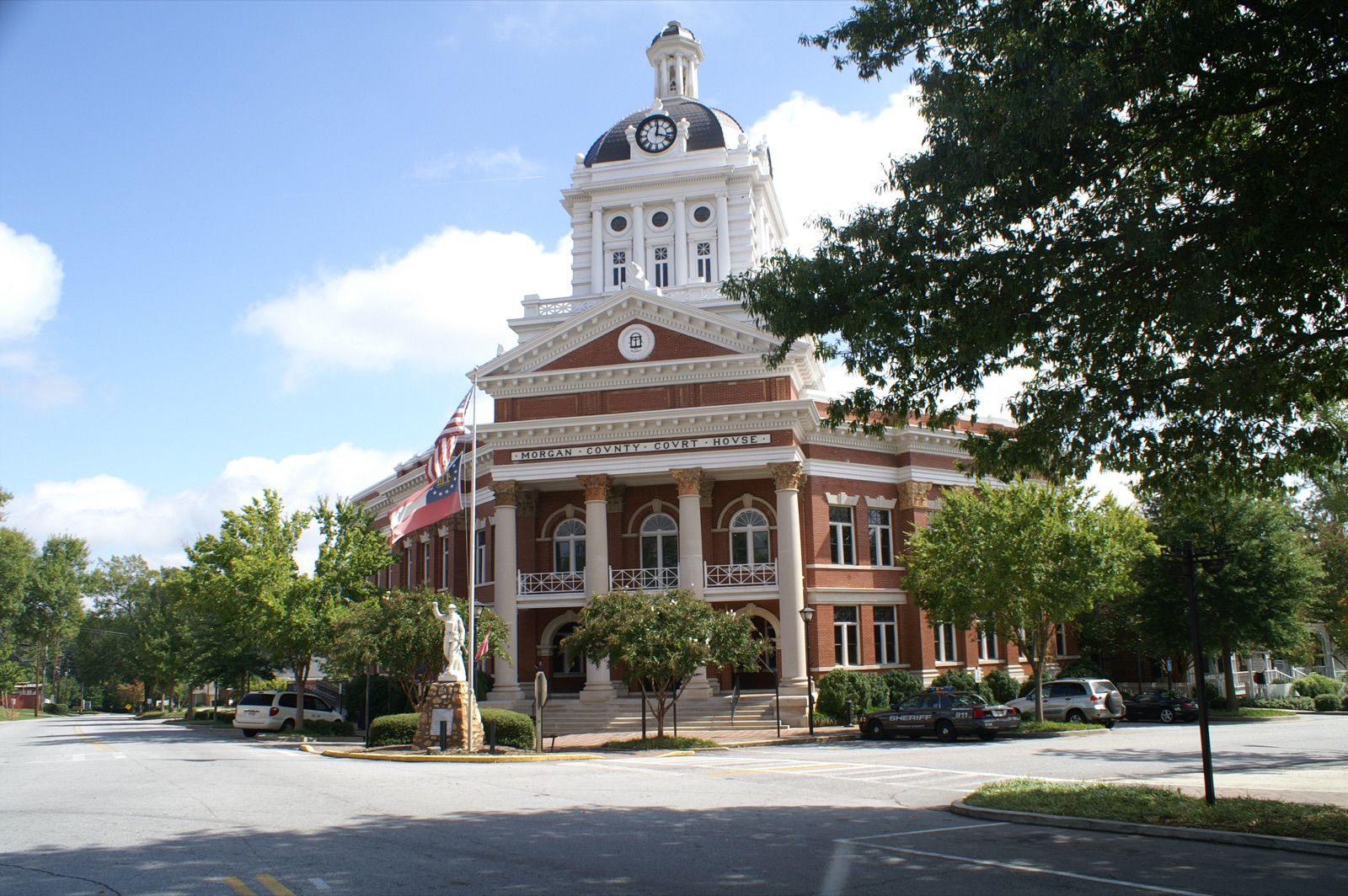
The courthouse square anchors all of it. Come at the hour when the shops are closing and the light goes long and gold across the brick, and you will see the town do the thing it has done every evening for longer than anyone alive can remember. Someone sweeps a doorway. Two men talk by a truck about nothing. The courthouse clock, which is usually close to right, says it is later than you thought.
Don’t miss the Madison-Morgan Cultural Center, an 1895 schoolhouse turned museum and theater, where the old classrooms still hold the proportions of a building that expected children to sit up straight.
Here is what I keep thinking about after a day in Madison.
A town that survives by accident, or by the kindness of one well-placed neighbor, learns something a town that was never threatened never has to learn. It learns that survival is not guaranteed and not deserved. It is a gift that has to be tended, or it goes the way of the sixty miles around it. Madison did not decide to be beautiful. It decided, every year for a century and a half, not to tear the beauty down. Those are different decisions, and the second one is the harder one, and it is the one most places quietly fail.
That is the real story under the Sherman story. Not that Madison was spared once, but that it has been sparing itself ever since.
The South, shared.
Keep Reading
Places
Abingdon, Virginia: The Town That Traded Ham for HamletIn the far corner of Virginia sits a handsome mountain town whose famous theater once let farmers pay for a play with produce. It is still going.
Places
The Lighthouses of the South, Part Two: The Gulf CoastThe second in our series on the beacons of the Southern coast. From Pensacola to Sanibel, the Gulf lights guard a flatter, trickier shore.
Places
The Lighthouses of the South, Part One: The Atlantic CoastThe first in a series on the beacons of the Southern coast. Seven Atlantic towers built to keep ships off the shoals, and worth the climb.