Photo: Carol M. Highsmith / Library of Congress
The Quilts of Gee's Bend
Most people who come to Gee’s Bend notice the river first. It loops so tightly around the community that the water nearly surrounds it, and that geography is the key to everything that followed, including the art. Officially the town is Boykin, in Wilcox County, deep in Alabama’s Black Belt. The river wraps it on three sides, and for most of the community’s history that meant near-total isolation. The people here are, in large part, the direct descendants of the enslaved men and women who worked the cotton plantation established in this bend in the early nineteenth century. After emancipation, many stayed on as sharecroppers and tenant farmers, and the isolation that came with the land shaped everything, including one of the most important bodies of art America has produced.
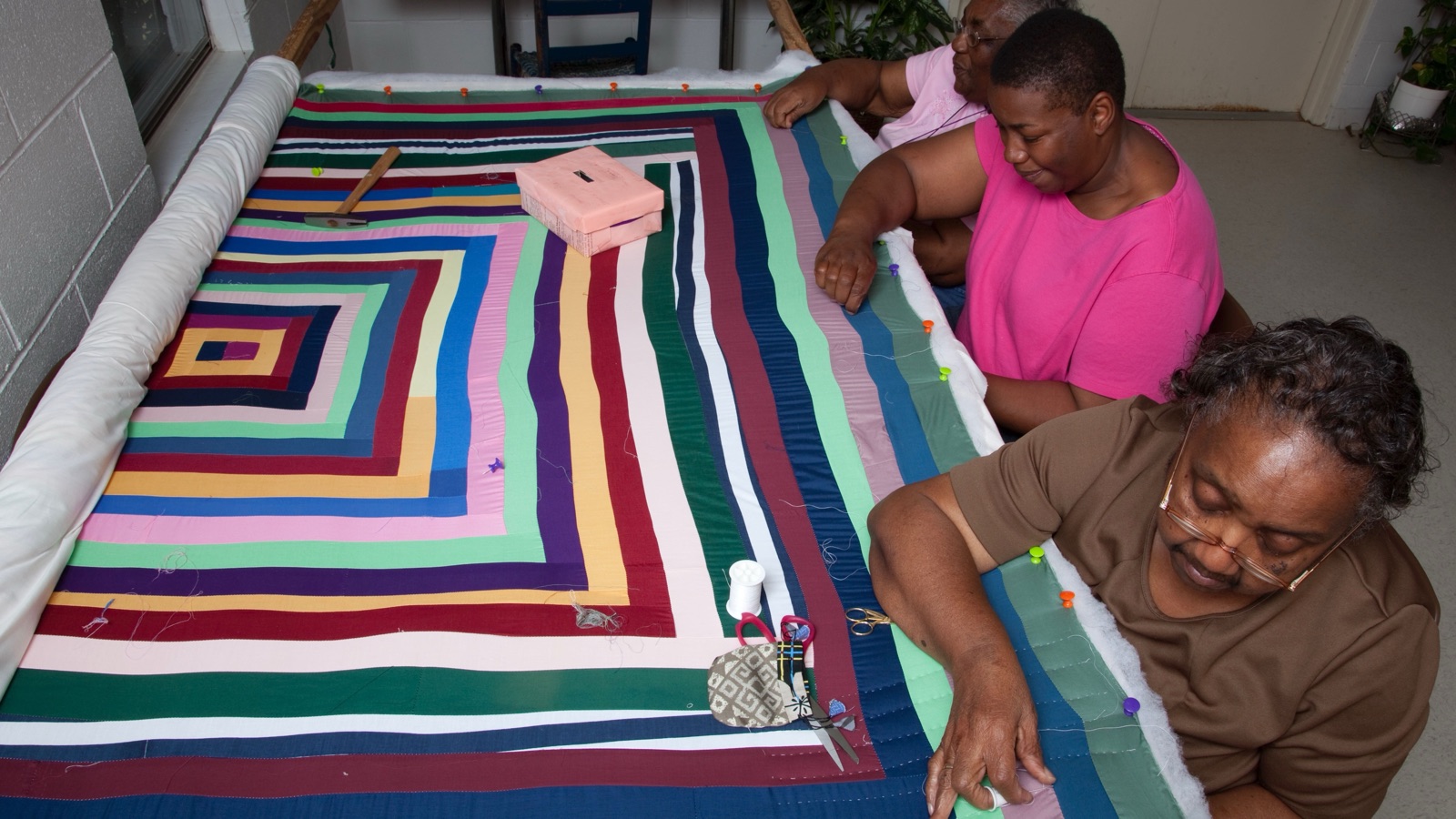
The women of Gee’s Bend made quilts because they had to. Homes went unheated through the Alabama winters, and a quilt was warmth before it was anything else. What they had to work with was scarcity: worn-out work clothes, feed sacks, dress scraps, fabric too far gone for any other use. So they pieced what they had, and out of that necessity came something no one taught them and no pattern book contained, a bold, improvisational style the quilters themselves call “my way” quilts. You begin with a basic form, then you follow your own eye, letting the colors and shapes fall where instinct sends them. The results are startling: off-kilter geometries, jazzy syncopated lines, a sophistication of color and composition that critics would later compare to modern abstract painting.
For generations, almost no one outside the bend saw them. The quilts kept families warm and were handed down, and the tradition passed mother to daughter the way such things do in a place set apart. The community’s isolation was real and sometimes punishing. In the civil rights era, after residents joined the marches and Dr. King visited nearby, the ferry that connected Gee’s Bend to the county seat at Camden was shut down, turning a short crossing into an hour’s drive and deepening the community’s separation for decades. The ferry did not run again until 2006.
Then, at the start of this century, the wider world finally looked. A landmark exhibition opened at the Museum of Fine Arts in Houston in 2002 and traveled to the Whitney Museum in New York, and the response was electric. Critics hailed the quilts as a major achievement of American art. The work traveled to museums across the country and around the world, and today Gee’s Bend quilts hang in the permanent collections of dozens of institutions on multiple continents. In 2006, the U.S. Postal Service issued a sheet of stamps reproducing ten of them. The women who had pieced warmth out of rags in an overlooked corner of Alabama were, at last, recognized as the artists they had always been.
The tradition continues. The quilters formed a collective, the Gee’s Bend Quilters Collective, to market and sell their work, and the craft still passes through the generations in Boykin, where descendants of the earliest known quiltmakers are working today. Each autumn the community holds an Airing of the Quilts, when the work comes out into the open air, generations of it, hung up across yards and porches for all to see.
That is the truest picture of the place: not the gallery walls in New York or Houston, but a Boykin yard in October, the quilts strung up in the open, the same river still curling around the town the way it always has.