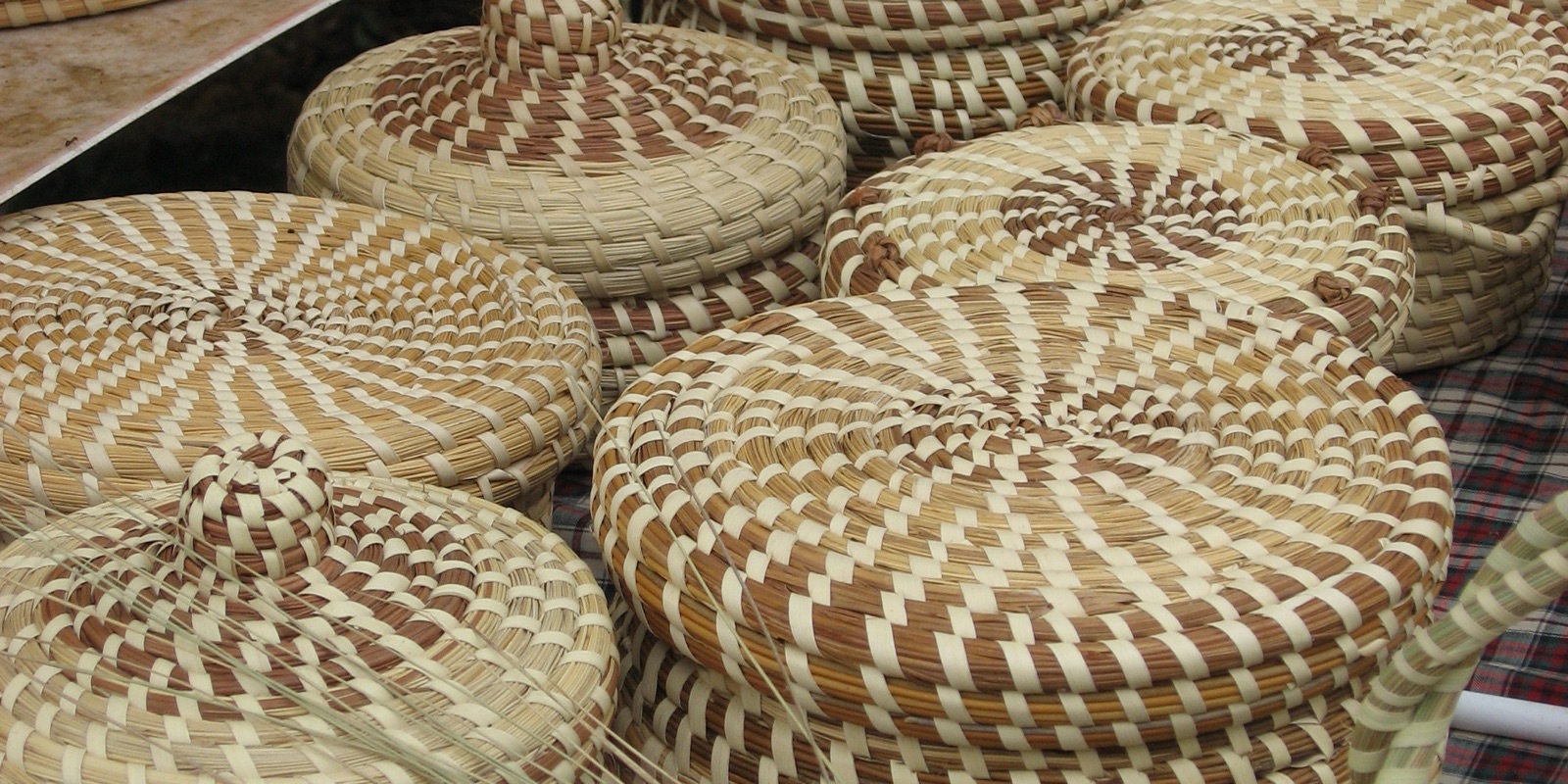
Photo: National Archives and Records Administration (public domain)
The Sweetgrass Basket Makers of the Lowcountry
The baskets are still made by hand, which in a world like ours is its own quiet astonishment.
Along Highway 17 north of Charleston, at wooden stands set up under the pines, you can still find them. Coiled bowls and trays and the tall-handled fanner baskets, the color of honey and straw, made by a method that has held in the Lowcountry for more than three hundred years. A woman sits with a bundle of sweetgrass in her lap and a thin strip of palmetto in her fingers, and she coils and binds and coils again, and a basket grows out of her hands so slowly you can watch it happen and still not quite see how.
The craft came across the ocean.
It was carried here by enslaved West Africans, who brought with them a knowledge of coiling grass that was older than anyone could say, and who used it in the rice fields of the Lowcountry to make the wide fanner baskets that separated rice from chaff. Those first plantation baskets were coiled from bulrush, a tougher marsh grass; the fragrant sweetgrass that gives the craft its name came to define it later, as the baskets turned from work tools into the pieces sold by the road today. The work was forced and the conditions were brutal, and out of that history the people held on to one thing that was wholly theirs, a skill that could be passed mother to daughter across generations that owned almost nothing else. That is the weight the baskets carry. They are beautiful, and the beauty is inseparable from the endurance.
The grass itself is part of the story. Sweetgrass grows in the dunes and marsh edges of the coast, and it is getting harder to find, squeezed out by development and gated fences and the slow paving of the places it likes to grow. The makers drive farther every year to gather it. Pull a handful fresh and it smells faintly of hay and the marsh, a green sweetness that hangs in the air around a finished basket for a long time after.
This is the part worth sitting with.
A sweetgrass basket is not a souvenir, though it is sold beside the road like one. It is a living artifact of one of the longest continuous craft traditions in America, kept alive across slavery and Reconstruction and Jim Crow and the bulldozers of the present by women who refused, generation after generation, to let it die. Each basket is hours of patient work that no machine has ever managed to copy, holding in its coils a line that runs unbroken back across the Atlantic.
When you buy one, and I hope you do, you are not buying a basket. You are paying a small part of the cost of keeping a three-hundred-year-old thread from being cut. That is about the best thing a few dollars can do.
The South, shared.
Keep Reading
Southern Stories
The Front Porch, Part Two: On the Art of Sitting a SpellWe wrote once about why the South built porches. This is about what people did on them: the lost art of sitting, watching, and letting the evening pass.
Southern Stories
The Courthouse Square, and the Town That Grew Around ItIn a thousand Southern towns, everything points to the same place: the courthouse on the square. Here is why it was built that way, and why it still holds.
Southern Stories
The Last of the Whole-Hog PitmastersCooking a whole pig over wood coals from dark to dawn is one of the oldest crafts in the South, and one of the fastest disappearing.