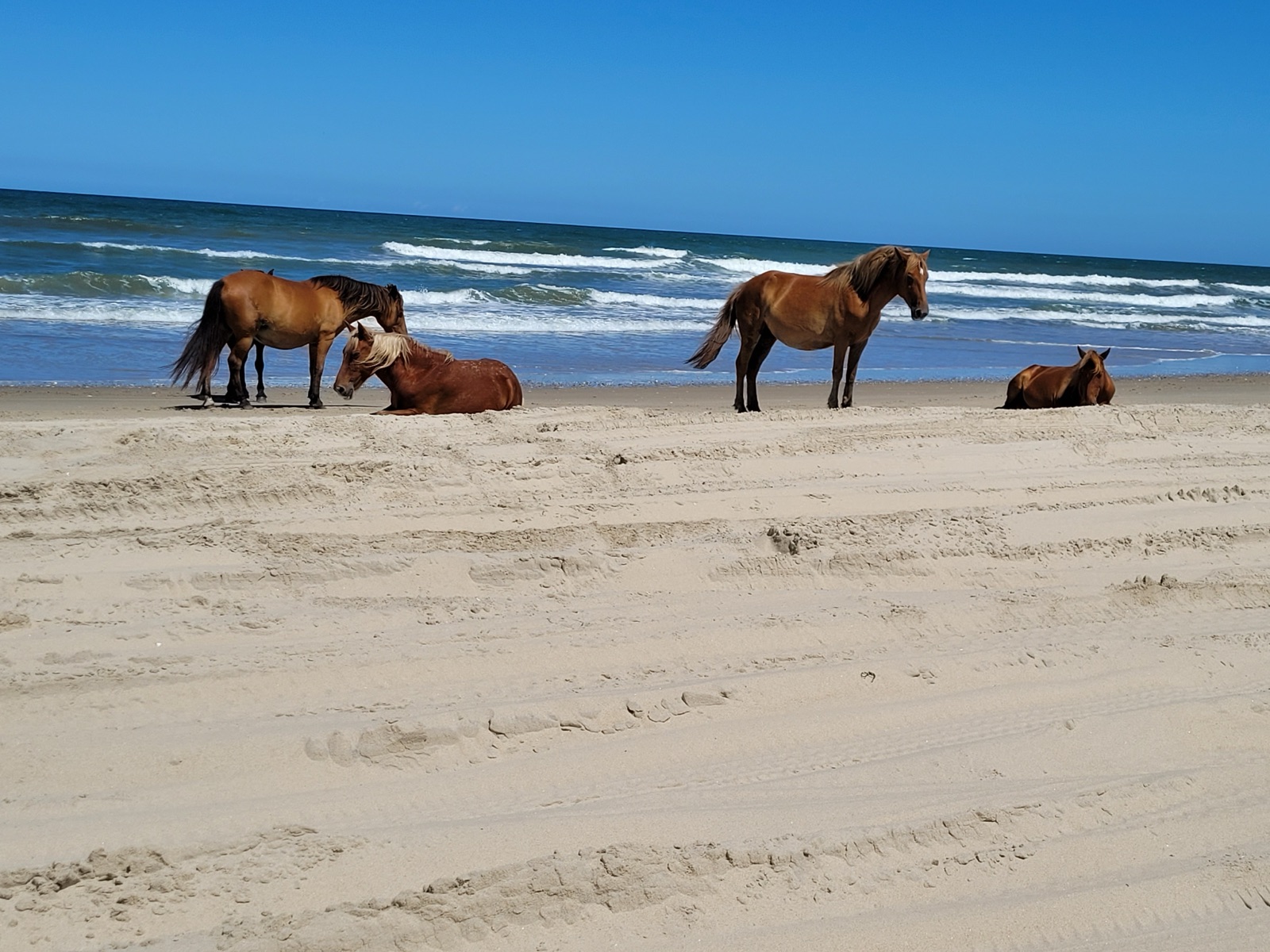
Photo: Kabongolei / Wikimedia Commons (CC BY-SA 4.0)
The Wild Horses of the Outer Banks, and the Land That Kept Them
At the far north end of the Outer Banks, past where the paved road quits and the beach itself becomes the highway, there are horses running loose on the dunes.
They have been there a very long time. They are Colonial Spanish Mustangs, descended from horses the Spanish brought to these shores as early as the 1520s, left behind or swum ashore from shipwrecks or the wreckage of failed settlements, and they have run wild on this thin strip of sand between the sound and the sea for something like five hundred years. They are small, tough, sand-colored things, bay and chestnut and black, built low and hardy by centuries of hard living on a barrier island. North Carolina named them the state horse. They are one of the oldest continuously wild horse populations in America, and to come over a dune and find a band of them grazing the sea oats, unbothered, wild, at home, is to see something that has been happening on this coast since before there was a country to have a coast.
They are not tame. That is the first thing to understand and the thing the signs will tell you over and over. You must stay fifty feet back, by law, and you must never feed them, because their stomachs have adapted over five centuries to sea oats and marsh grass and the brackish water they find by pawing holes in the sand, and a well-meaning tourist’s apple can kill one. They dig for their own fresh water. They shelter from the hurricanes as best they can. They live, as they always have, on what the island gives them and nothing more.
The thin thread
Here is what will surprise you. This herd, ancient and iconic and running wild on land that looks like the last empty place in the East, is only about a hundred horses. And keeping even that hundred alive has taken deliberate, stubborn, unglamorous human work.
For most of their history the horses simply endured, out of sight and out of mind at the empty top of the Banks. But in the late 1980s the road was paved north toward Corolla, and what was good for tourists turned deadly for the horses. They were struck by cars. They wandered into the new developments. The herd, left to collide with the modern world on its own, would not have lasted. So in 1989 a handful of people formed the Corolla Wild Horse Fund, and they did the hard, patient things that keeping a wild thing wild actually requires. They built a sound-to-sea fence. They put a cattle guard across the road. They moved the horses north of the development, into the emptier country. They began to watch the herd, horse by horse, tracking every birth and death.
They still do it. The Fund manages the herd’s health, darts the mares with contraception to keep the population in a sustainable range, responds when a horse is sick or hurt or has grown too comfortable around people, and fights the slow genetic problem that comes from a herd this small and this isolated. The Corolla horses, it turns out, descend almost entirely from a single maternal line, which makes them precious and makes them fragile, and the people who look after them work with the herd down at Shackleford Banks to the south to keep the bloodline from narrowing to nothing. None of this is visible when you stand on the dune watching them graze. But all of it is the reason there is anything there to watch.
What wild costs
There is a lesson in these horses that goes a little against the grain of the word “wild.”
We like to think of wildness as the absence of people, as what happens when human beings finally leave a thing alone. And there is truth in that. The horses are wild because they live free on the land, feeding themselves, breeding on their own terms, owing nothing to anyone. But the hard fact of the modern world is that a wild thing surrounded by roads and development and well-meaning crowds does not stay wild by being left alone. It stays wild because people decided it should, and then did the fencing and the counting and the patient tending that decision requires.
That is the quiet paradox standing on the dunes at Corolla. These horses are as wild as anything in the East, and they are wild on purpose, kept that way by a community that looked at a five-hundred-year-old herd and decided it would not be the generation that let them vanish under the wheels of the future. Storms have hurt them. A single bad hurricane once cut a nearby herd in half in an hour. The threats are real and the margin is thin. And still they run, black and bay and chestnut against the sea oats, because enough people cared enough to make sure they could.
Go see them if you can, from the respectful distance the law requires. Watch a band move along the tideline the way their ancestors did when the Spanish ships were still on the horizon. And know, as you watch, that the wildness in front of you is one of the things the South decided was worth keeping, and kept.
The South, shared.
Keep Reading
Coastal South
Sanibel, and the Beach That Catches the Sea's Best WorkOne Florida island turns sideways to the Gulf and catches what the water carries. The result is the finest shelling beach in North America.
Coastal South
Cumberland Island, Where the Horses Run WildGeorgia's largest barrier island is a place of empty beaches, Gilded-Age ruins, and a herd of feral horses found nowhere else on the Atlantic coast.
Coastal South
A Quiet Morning in the Lowcountry MarshBefore the heat settles in, the Lowcountry marsh offers a still, golden hour that's worth waking up for.