The Blacksmith, and the Oldest Fire in Town
For most of human history, the most important building in any town was the one with the fire in it.
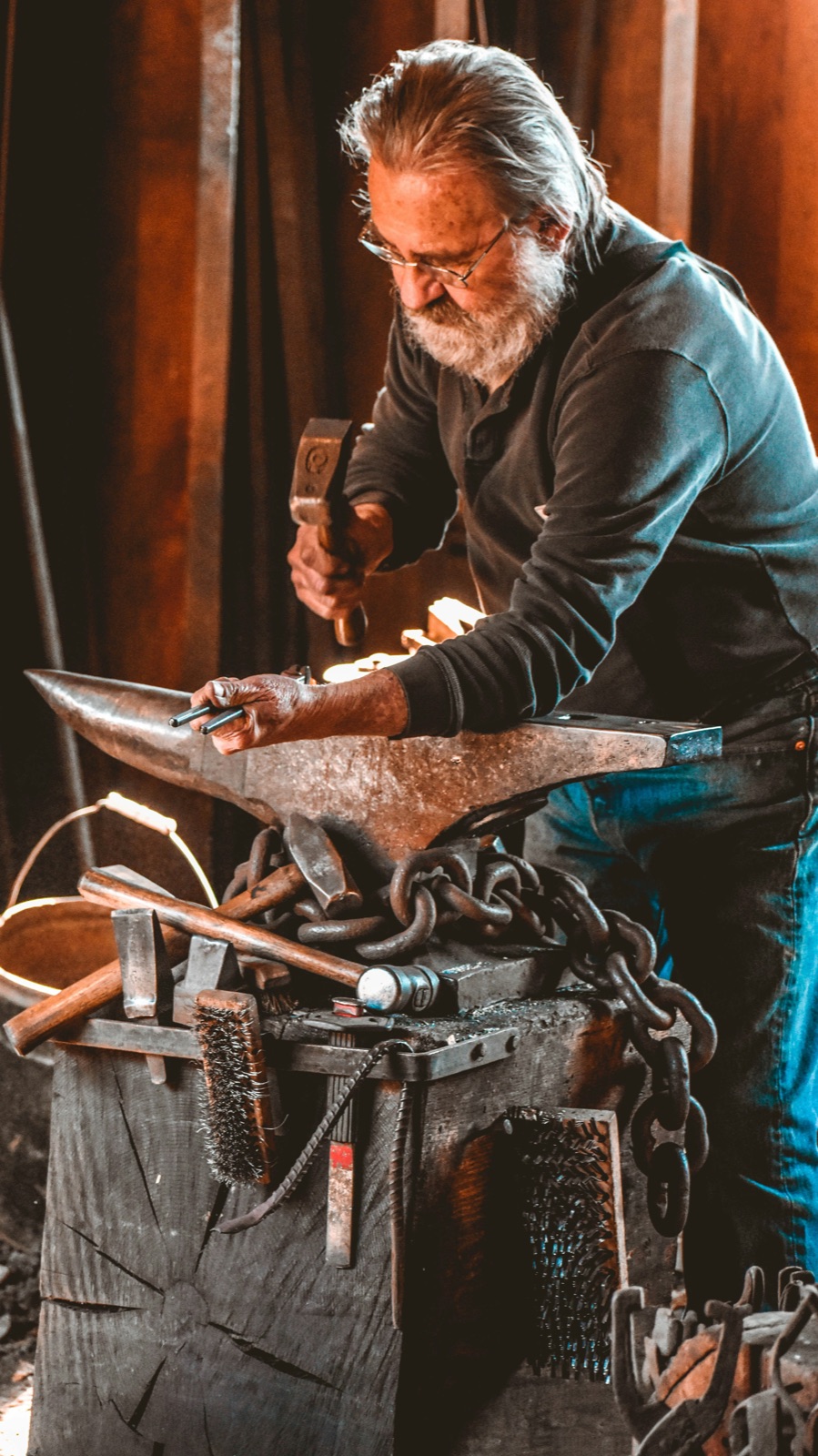
The blacksmith’s shop was where the town was made and mended. Before the factory and the hardware store, before you could order a part or buy a tool off a shelf, there was the smith, and the smith made nearly everything a community needed out of iron and fire and muscle. The hinges on your door and the shoes on your horse, the nails in your house, the blade of your plow, the pot over your hearth, the tools every other tradesman used to do his own work: all of it came, red-hot and hammered, off the smith’s anvil. Every Southern town had one, usually near the center, and the ring of hammer on iron was one of the sounds a town made, as steady and expected as the church bell.
The trade is old almost beyond reckoning. People have been heating iron and shaping it this same essential way for thousands of years, and the astonishing thing about a blacksmith working today is how little the fundamentals have changed. The fuel might be different, the ventilation better, but the heart of it, the fire and the anvil and the hammer and the hot iron yielding to the blow, is the same craft a smith would have recognized a thousand years ago, or two thousand. To watch it done is to watch one of the genuinely ancient human skills, still alive, still in a pair of hands.
Fire, iron, hammer, time
The work looks simple and is not, which is true of most things done well.
It begins with the fire, and managing the fire is the first skill. The smith heats the iron in the forge until it glows, and the color of that glow is a language the smith reads without thinking: a dull red is one temperature and one range of possibility, a bright orange another, a near-yellow another still, each color telling the smith exactly how the metal will behave under the hammer at that moment. Too cool and the iron will not move and may crack. Too hot and it burns, sparks flying, ruined. The smith learns to read the heat by eye, in the dim of the shop where the colors show true, and to pull the iron at the exact instant it is ready.
Then the shaping, and the shaping is where the years of practice live. Hot iron does not carve or cut. It moves, flowing under repeated blows like something between solid and liquid, and the smith drives it into shape one hammer stroke at a time, against the anvil, turning and striking and turning again, working fast because the iron is cooling with every second and will have to go back into the fire before long. There is a rhythm to it, the ring of the hammer, and there is a deep bodily knowledge in it, the smith’s whole frame behind each blow, the angle of the hammer and the force of it dialed in by ten thousand repetitions until the hands know what the mind could never calculate. Draw the iron out long, or upset it thick, or bend it, or split it, or weld two pieces into one in the fire, each an old technique, each learned only by doing.
And then the finishing, the filing and the tempering, the careful reheating and cooling that sets the hardness of a blade or the spring of a hook. A thing made at the forge is made slowly, in stages, with the metal going into the fire and back onto the anvil many times before it is done. There is no rushing it. The iron sets the pace, and the smith keeps time.
Why the fire still burns
The world does not need the village blacksmith the way it once did. The nails and hinges and tools come off assembly lines now, cheaper and faster than any smith could match, and the trade that once stood at the center of every town could have gone the way of so many others, remembered only in the name of a street or the sign on a museum.
But it did not go. The craft survives, in the hands of smiths who kept the fire lit, who make by hand the things that are better made by hand, the gate and the railing and the fireplace set and the knife, the pieces where the mark of the hammer and the slight beautiful irregularity of hand-forged iron are the whole point. And it survives because there turns out to be something people cannot get from a factory and will always want, which is an object made by a person, at a fire, one blow at a time, carrying in its shape the record of the hands that made it.
There is a reason the blacksmith holds such a deep place in our imagination, why the forge shows up in the oldest stories we tell, why we made it a symbol of making itself. To stand iron in a fire until it glows and then beat it into a useful and beautiful shape is one of the fundamental human acts, close to the root of what separated us from the animals. Every smith still working keeps that root alive, keeps the oldest fire in town burning, and hands the ancient knowledge forward to whoever cares enough to learn it. The ring of hammer on anvil is a very old sound. It is good to know there are still places in the South where you can hear it.
The South, shared.
Keep Reading
Southern Makers
The Dulcimer Makers, and the Sound That Came Down the MountainsThe Appalachian dulcimer is the rare American instrument, born in the mountain South. The people who still build them by hand keep a whole tradition alive.
Southern Makers
The Decoy Carvers of the Southern CoastA working duck decoy is just a block of wood carved into a bird, but on the Southern coast it carries three hundred years of craft handed down.
Southern Makers
Seagrove, Where the Clay RemembersIn a rural pocket of North Carolina, more than a hundred potters work the same red clay their predecessors dug 250 years ago.