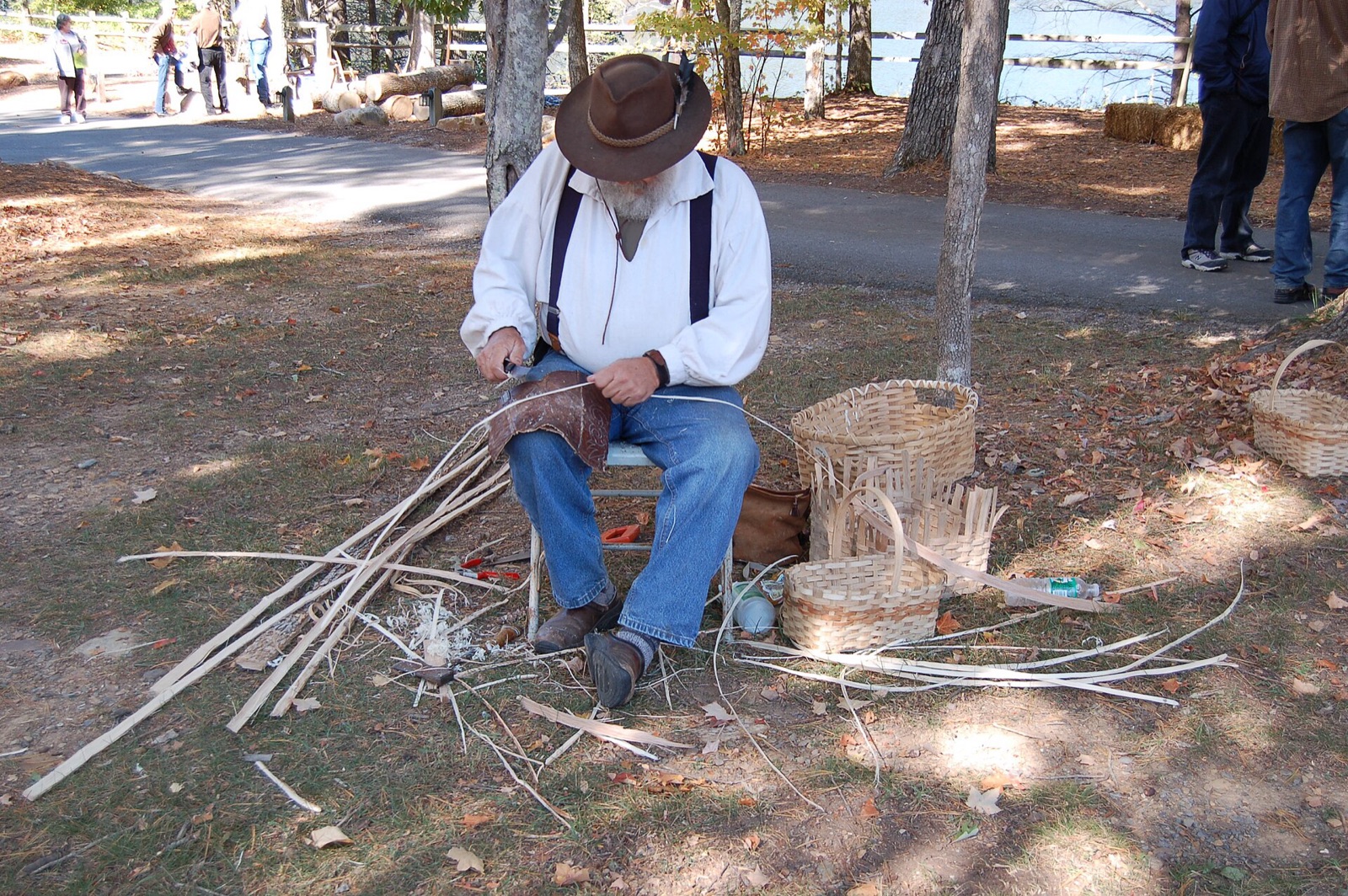
Photo: Virginia State Parks / Wikimedia Commons (CC BY 2.0)
The White Oak Basket Makers of Appalachia
A basket begins with a tree, and a person standing under it in the woods, trying to read it.
That is the part most people never think about. We see the finished thing, the tight handsome basket with its ribs and its weave, sitting on a shelf at a mountain craft fair with a modest price tag on it. We think of it as a woven object. But up in the Appalachian South, among the few who still make baskets the old way, the real work happens long before anybody weaves anything. It happens in the woods, with an axe and an eye, choosing the one white oak that will give up its wood in long clean splits.
Not every oak will do it. The maker wants a young tree, straight-grained, free of knots and twist, grown where it had to reach for its light so the grain ran true. An experienced hand can walk a mountainside, pass a hundred trees, and stop at one.
That is the whole trade in one gesture. Seeing what the rest of us walk right past.
Then comes the hard part, and it is genuinely hard. The tree is felled and cut to length. The maker rives it, splits it down and down again along the grain, with a froe and a mallet and finally with nothing but hands and teeth and stubbornness, working the wood into thin, flexible splits. White oak gives this way because of how it grows, in tight annual rings that peel apart clean if you know how to coax them. It is skilled, sweaty, unforgiving labor. Rush it and the split runs out, tears across the grain, and you have wasted a good piece of a good tree.
Only after all of that, the finding and the felling and the riving and the shaping, does the weaving begin.
The weaving, honestly, is the easy part.
This craft runs in families and in places, handed down the way a way of talking is handed down, mother to daughter, uncle to nephew, on porches and in barns across the mountain South. It was never a hobby. It was how you got the baskets you needed to work a farm, to gather eggs, to bring in the beans, to carry the wash. A well-made white oak basket was a tool built to take decades of hard daily use. There are baskets still in service in mountain homes older than anyone living in the house.
That is the quiet miracle of it. In a world that taught us to buy the cheap version, use it up, and throw it out, here is an object made by hand, from a single tree, designed from the start to outlast the person who made it. A white oak basket is not disposable. It is nearly the opposite. It is an heirloom that happened to start life as a chore.
This is not really a story about baskets.
The makers who are left are not many, and most are not young. It is slow work for small money, and the world does not beat a path to it. But go to the right mountain fair of a fall weekend and you will find them, sitting behind a table of their baskets, hands scarred and sure, happy to tell you which tree a particular basket came from if you ask.
Buy one if you can. Not because you need a basket. You can get a basket anywhere. Buy it because it is one of the last honest objects, made the slow way by a real hand from a real tree, and because every one that finds a home is a small vote for a kind of work the world keeps trying to forget. Set it on your shelf. Kept dry and used gently, it will very likely still be sitting on somebody’s shelf long after all of us are gone.
That was always the idea.
The South, shared.
Keep Reading
Southern Makers
The Blacksmith, and the Oldest Fire in TownThere was a time every Southern town had a forge at its heart. The smiths still working by hand keep alive one of the oldest crafts there is.
Southern Makers
The Dulcimer Makers, and the Sound That Came Down the MountainsThe Appalachian dulcimer is the rare American instrument, born in the mountain South. The people who still build them by hand keep a whole tradition alive.
Southern Makers
The Decoy Carvers of the Southern CoastA working duck decoy is just a block of wood carved into a bird, but on the Southern coast it carries three hundred years of craft handed down.