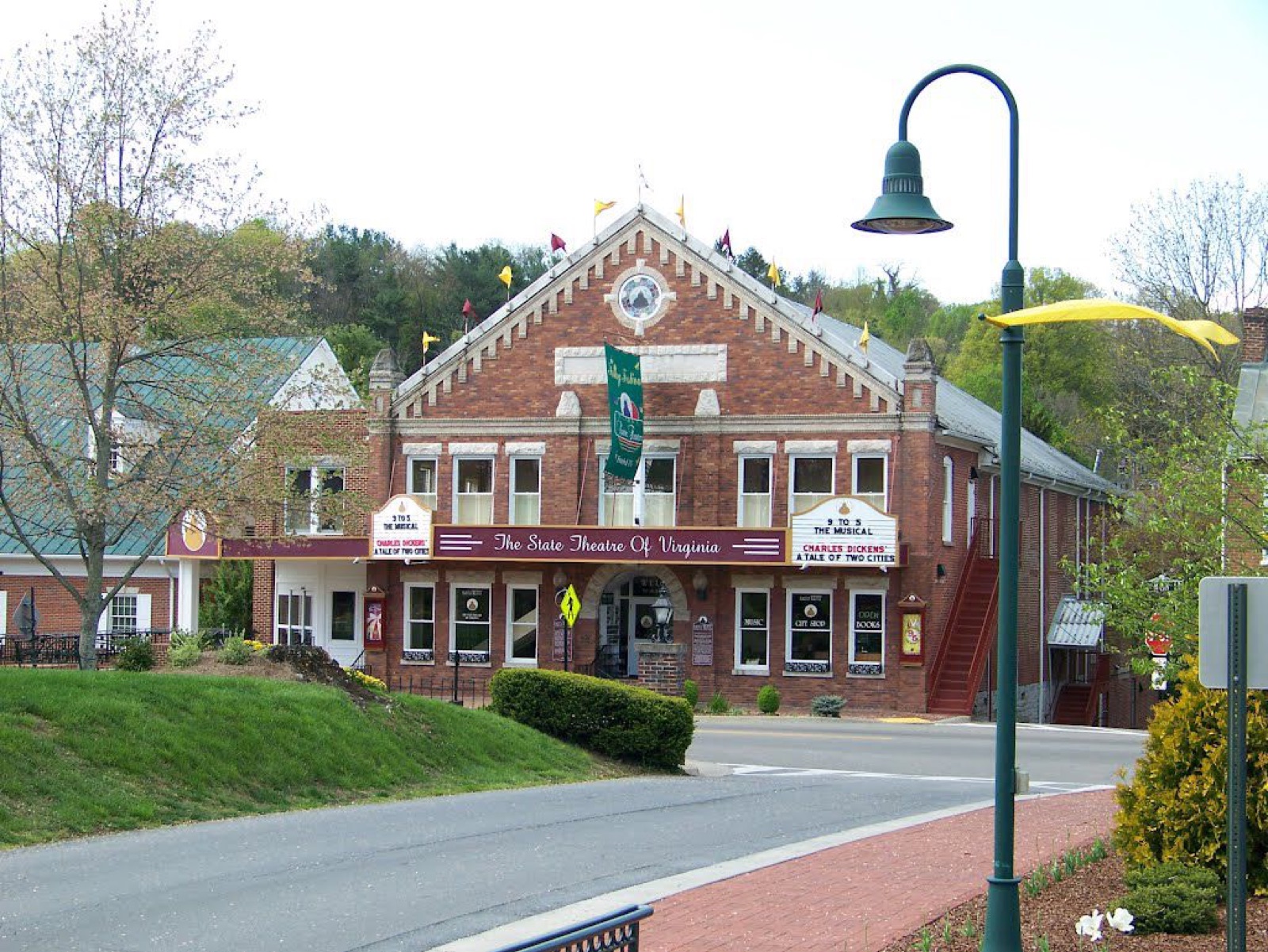
Photo: Upstateherd / Wikimedia Commons (CC BY-SA 4.0)
Abingdon, Virginia: The Town That Traded Ham for Hamlet
In the far southwestern corner of Virginia, wedged up in the tip where the state runs out and Tennessee and Kentucky and North Carolina all crowd close, sits a town that once let you buy a night at the theater with a ham.
Abingdon is a handsome place on its own merits, a small mountain town of around eight thousand people strung along a historic Main Street of brick storefronts and old churches and a fine 1868 courthouse, sitting in the high country where the Blue Ridge gives way to the Appalachian plateau. It is on the Crooked Road, Virginia’s music heritage trail, and it has the galleries and craft studios and the old grand hotel that a town this pretty tends to collect. On looks alone it would be worth the drive, one more well-kept mountain town among the South’s many.
But Abingdon has something the others do not, and it is one of the great small stories in American culture. It has the Barter Theatre, and the Barter Theatre began with a young man’s very good idea in a very bad year.
Ham for Hamlet
The year was 1933, the depth of the Great Depression, and the idea belonged to a Southwest Virginia actor named Robert Porterfield.
Porterfield had gone off to New York to make it on the stage, and he had watched the Depression close the theaters and throw his fellow actors out of work, hungry and stranded in a city that could no longer afford them. Back home in the Virginia mountains, meanwhile, the farmers were in the opposite bind: they had food, crops and livestock and dairy, but no money and no market, produce rotting in the fields because nobody could buy it. Porterfield looked at those two problems, the hungry actors and the broke farmers, and saw that each was the other’s answer.
So he brought a company of actors down from New York to Abingdon and opened a theater on a simple, brilliant premise. If you could not afford the price of admission, which was forty cents, you could pay your way in with produce. A ham. A dozen eggs. A chicken, a sack of vegetables, a jug of milk. The theater’s slogan said it plainly: “With vegetables you cannot sell, you can buy a good laugh.” They called it the Barter Theatre, and on opening night in June of 1933, four out of five people who came through the doors paid not in coins but in food. The actors were fed. The farmers got their night at the play. And a Depression-born experiment that by all rights should have lasted one desperate season instead became an institution.
The stories from those early years are wonderful. The company’s slogan for the whole enterprise became “ham for Hamlet.” At the end of that first season the theater had cleared just over four dollars in actual cash, plus two barrels of jelly and, by the actors’ own accounting, a collective weight gain of some three hundred pounds. That is a theater company paid in supper, and glad of it.
Still on the stage
Here is the part that lifts the Barter from a charming anecdote to something genuinely remarkable. It never closed.
The Barter Theatre survived the Depression that birthed it, survived the war, and kept right on going, decade after decade, until it became the longest-running professional theater in the United States and the official State Theatre of Virginia. Its stage turned into a proving ground for actors who went on to become enormous, names you would know, who learned their craft in this small mountain town before the world had heard of them. One future Hollywood legend, the story goes, went door to door through Abingdon borrowing props for Barter productions back when he was just a tall unknown young man, though people tended to lend him what he asked for anyway.
And it is still running now, today, a working professional theater drawing well over a hundred thousand people a year into a town of eight thousand, staging its plays in repertory so that a visitor over a single weekend might catch several different productions. The old bartering days are honored still: once a year the Barter holds days when you can trade a donation of canned goods for a ticket, the food going now to a regional food bank, the spirit of 1933 kept deliberately alive.
That is the thing that makes Abingdon more than a pretty mountain town. A great many places have a handsome Main Street. Almost none have, at the center of that Main Street, a living ninety-year-old monument to one of the most humane ideas the hard years ever produced, the idea that art and supper could keep each other alive, that a hungry actor and a broke farmer could save one another, that in the worst of times a community could figure out how to feed itself and be fed in more than one sense at once.
Come for the theater. Stay for the town, the mountain air and the old brick streets and the Crooked Road music drifting out of the venues at night. But go to a play while you are there, and as you take your seat, remember that the person who sat in it ninety years ago may well have paid for the privilege with a chicken. There is no more Southern story than that, and Abingdon has been telling it, from the same stage, for nearly a century.
The South, shared.
Keep Reading
Places
The Lighthouses of the South, Part Two: The Gulf CoastThe second in our series on the beacons of the Southern coast. From Pensacola to Sanibel, the Gulf lights guard a flatter, trickier shore.
Places
The Lighthouses of the South, Part One: The Atlantic CoastThe first in a series on the beacons of the Southern coast. Seven Atlantic towers built to keep ships off the shoals, and worth the climb.
Places
Edenton, North Carolina: Where Women Told a King NoA quiet bay town that was North Carolina's first colonial capital, home to the state's oldest working courthouse and an early women's political protest.