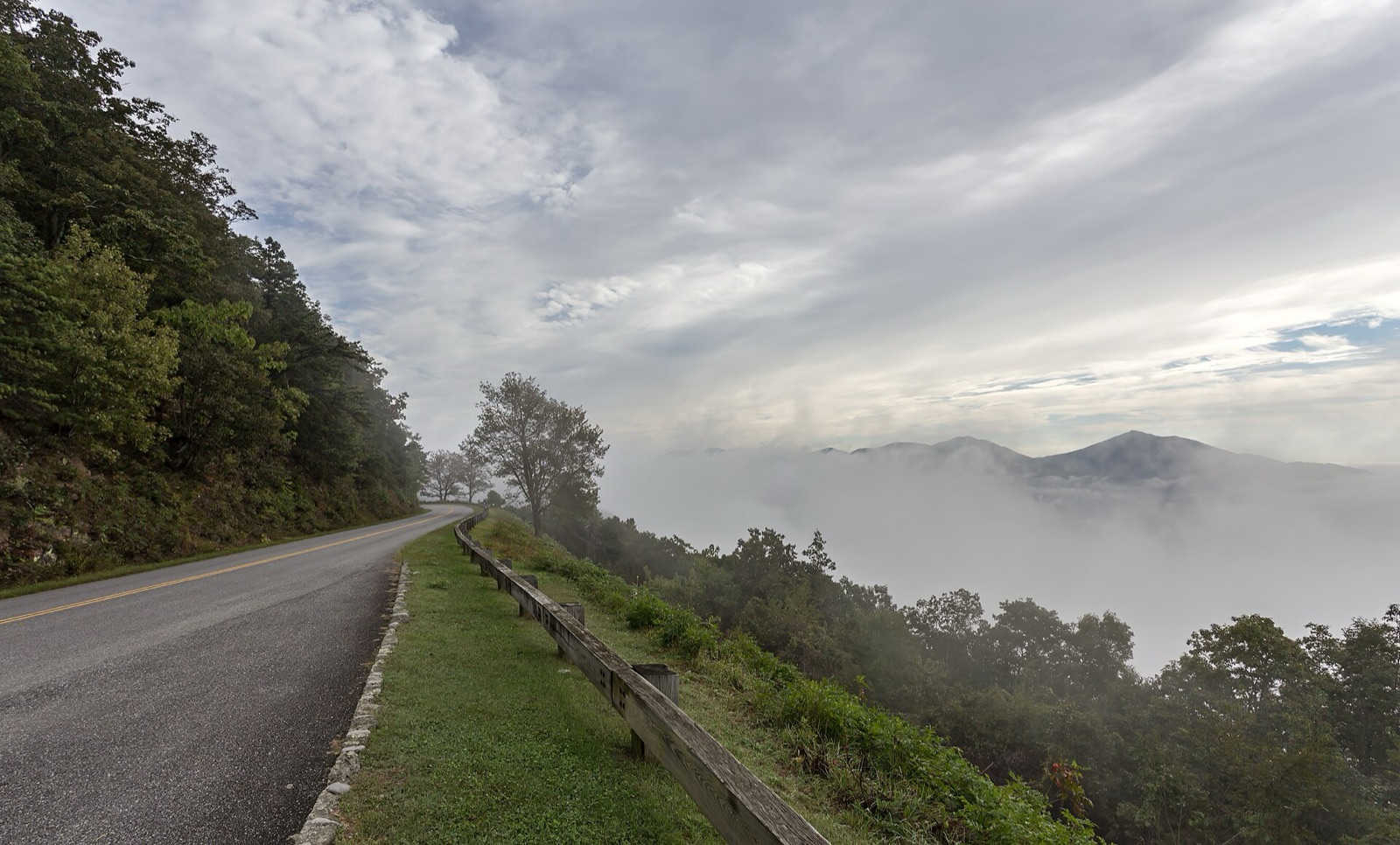
Photo: Acroterion / Wikimedia Commons (CC BY-SA 4.0)
The Blue Ridge Parkway: The Most Beautiful Drive in the South
There is a road along the top of the Southern mountains that was built for no purpose except to be beautiful.
It runs four hundred and sixty-nine miles. In the month of October it becomes, without much argument, the most beautiful drive in America. It is the Blue Ridge Parkway. If you have never given yourself over to a full day on it in the fall, you have a wonder waiting for you.
Start with what it is, because it is a genuinely unusual thing. The Parkway runs the spine of the Blue Ridge Mountains from the Shenandoah country of Virginia down to the edge of the Great Smokies in North Carolina. It connects Shenandoah National Park at its north end to Great Smoky Mountains National Park at its south. 469 miles of ridgeline. And it was built in the depths of the Great Depression, as a public works project, hand-laid by work crews of young men given jobs in a desperate time. A road whose entire reason for being was to let ordinary Americans drive through the mountains and see how beautiful their own country was. Ground was broken on the eleventh of September, 1935, up near Cumberland Knob on the North Carolina line, with about a hundred men clearing the first of the land by hand.
And here is a fact that tells you everything about the care that went into it. It was not finished until 1987. Fifty-two years.
The final stretch was the Linn Cove Viaduct, the graceful curving bridge that swings out around the shoulder of Grandfather Mountain. It was left for last precisely because it was so difficult and so delicate. Rather than blast a roadbed into the fragile slope and scar it forever, the engineers chose to float the road out past the mountainside on a curving concrete viaduct, built from the top down so the construction itself would barely touch the ground below. It was dedicated in September of 1987, fifty-two years to the month after the first men picked up their tools at Cumberland Knob. Half a century to build one road, because they refused to do it any way but right.
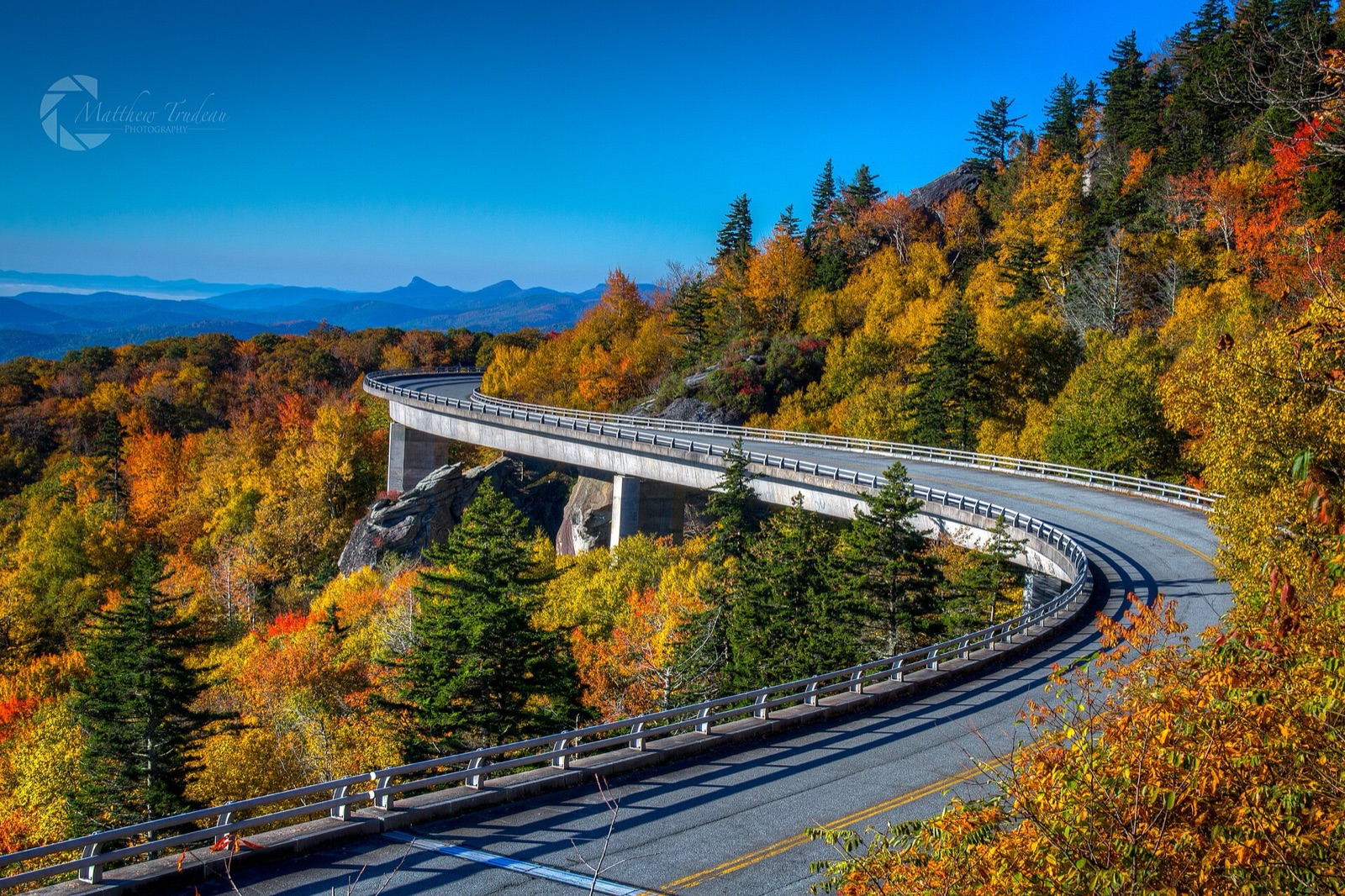
And the rightness is in every mile. The Parkway is a road with the noise of the modern world deliberately stripped out of it. There are no billboards. There are no traffic lights. There is no commercial traffic; the trucks are barred, and there is nothing to sell you and nowhere flashing to stop. There is no fee to drive it. The speed limit tops out at a gentle 45, and honestly you will want to go slower. Distance is measured not in exits but in mileposts, little numbered markers from 0 in the north to 469 in the south, and you learn to navigate your whole day by them. In every deliberate detail, it is a road designed to make you slow down and look. In an age when every other road is engineered to hurry you through the landscape, here is one built to hold you in it.
It has been the most-visited stretch of the entire national park system nearly every year since the 1940s, which has earned it the nickname America’s Favorite Drive. The numbers are earned. But numbers do not tell you what it is like to actually be up there. The Parkway rides the very crest of the mountains, so the views open out on both sides at once. Ridge after blue ridge rolling away to the horizon, the folds of the Appalachians going soft and hazy and blue in the distance, which is exactly how these mountains got their name. You pull off at an overlook, and there is the whole world spread out below and beyond you. Mountains as far as you can see, and not a billboard or a strip mall or a stoplight anywhere in it. Just the ancient mountains, and the road, and the sky.
Let me give you a few of the stops, milepost by milepost, so you can see how a day on it might go. Come down out of Virginia and you will pass the Peaks of Otter, three mountains standing over a still lake, one of the oldest resort spots in the whole range. A little farther south, at milepost 176, you reach Mabry Mill, an old water-powered grist mill sitting beside its pond. It is said to be the single most photographed spot on the entire Parkway, and when you round the bend and see it you will understand why. The weathered mill, the wheel, the water, the reflection, the whole vanished mountain world in one perfect frame. Farther on come the high wild places, Craggy Gardens with its rhododendron balds, and near milepost 382, just outside Asheville, the Folk Art Center, home of the Southern Highland Craft Guild, where the finest Appalachian craft, the very baskets and brooms and pottery and quilts we have been celebrating all season, are gathered under one roof.
Keep going and the road climbs into the sky. At milepost 431 you reach Richland Balsam, the highest point on the Parkway itself, six thousand and fifty-three feet up, where the air is thin and cool and the trees turn to the dark firs of the far north. Not far off the road near milepost 355, a spur runs up to Mount Mitchell, the highest peak in all of eastern America at six thousand six hundred and eighty-four feet, higher than anything east of the Mississippi River. You can drive nearly to the top of the East’s highest mountain and stand up there with the whole Appalachian world falling away beneath your feet.
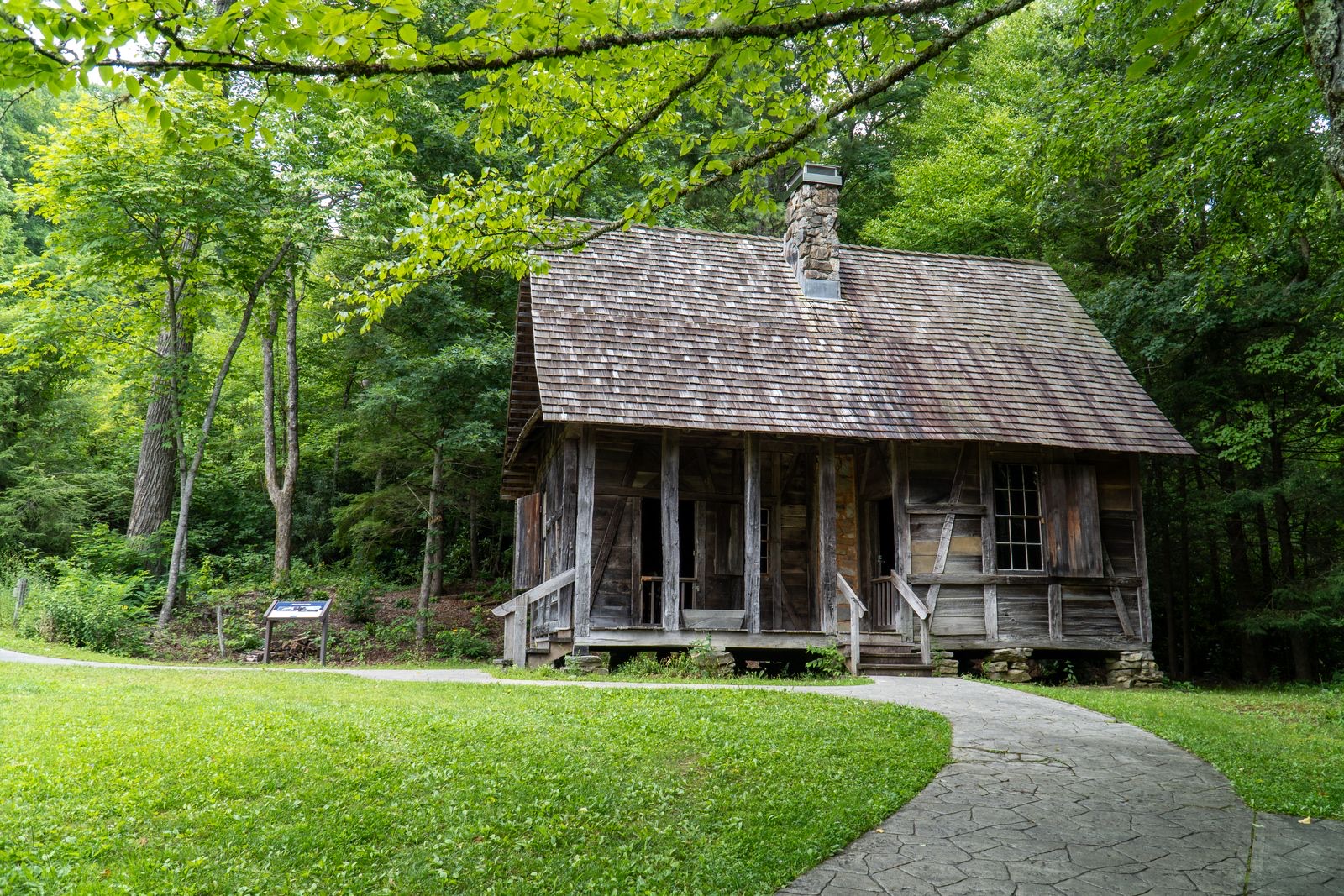
The Parkway does not just show you the mountains, either. It shows you the people who lived in them. All along its length it preserves the old mountain culture: pioneer cabins and grist mills like Mabry left standing, split-rail fences, old homesteads, mile after mile of the human story of these hills laid gently alongside the natural one. You can stop at a restored mountain farm and stand where a family scratched a hard living out of a steep hollow a century ago. And you understand a little better the tough, beautiful, self-reliant culture that these mountains bred, the very culture that gave us so many of the crafts and songs and foods we treasure.
Now put October on it. Because that is when the Parkway stops being merely one of the great drives in America and becomes something close to a religious experience. The Southern Appalachians put on one of the finest fall color displays on earth, and the Parkway runs right through the heart of it, up high where the color is best. And because the Parkway climbs and falls through so many thousands of feet of elevation, the color does not come all at once. It comes down the mountain. Up on the highest peaks, at six thousand feet, the color turns in the first days of October. Then it works its way down the slopes through the middle of the month, and finally reaches the valleys and the foothills by early November. Which means that all through October you can chase the peak up and down the mountainsides, always finding it somewhere. The maples going scarlet and orange, the birches and poplars turning gold, the oaks deep russet and bronze, all of it washing up the ridges and down the hollows and rolling away to the horizon in every shade of fire. Drive it on a clear day at the height of the color and you will round a curve and come on a view so overwhelming you will have to pull off just to take a breath.
I could go on naming the overlooks and the waterfalls and the high balds. But I would rather just tell you to go. Pick a clear day in October. Get on the Parkway at whatever end is nearest you, and give it the whole day. Roll the windows down. Go slow. Pull off at the overlooks, all of them if you have time. Stop at Mabry Mill and watch the wheel turn. Let the ridges roll away blue and burning to the horizon. Eat your lunch at a picnic table six thousand feet up with the whole autumn world spread out below you.
Do not hurry. That is the whole point of the road, and it is the whole point of the season, too. The Blue Ridge Parkway was built, at enormous cost and over half a century, by people who believed that the plain act of driving slowly through a beautiful place, with nothing to sell you and nowhere to rush, was worth giving to their fellow Americans. Worth taking fifty-two years and a bridge that floats around a mountain to do right. In October, on the crest of the burning mountains, you will understand exactly what they meant. And you will be grateful, all the way down, that they took the time.
The South, shared.
Keep Reading
Places
The Haunted South: Hayrides, Ghost Stories, and the Best Fun of the FallThe South does the spooky season better than anybody, and for the fun of it: hayrides, corn mazes, porch ghost stories, the happiest shiver of the year.
Places
The Southern Fair: Blue Ribbons, Midway Lights, and the Season of Coming TogetherThe midway lights, the livestock barns, the blue-ribbon pies, and a whole county gathered up in one glowing place. A love letter to the fair.
Places
Abbeville, South Carolina: The Town Where a Confederacy Began and EndedAbbeville holds a heavy distinction: where the Confederacy was first cheered into being, and where, five years later, it quietly ended.