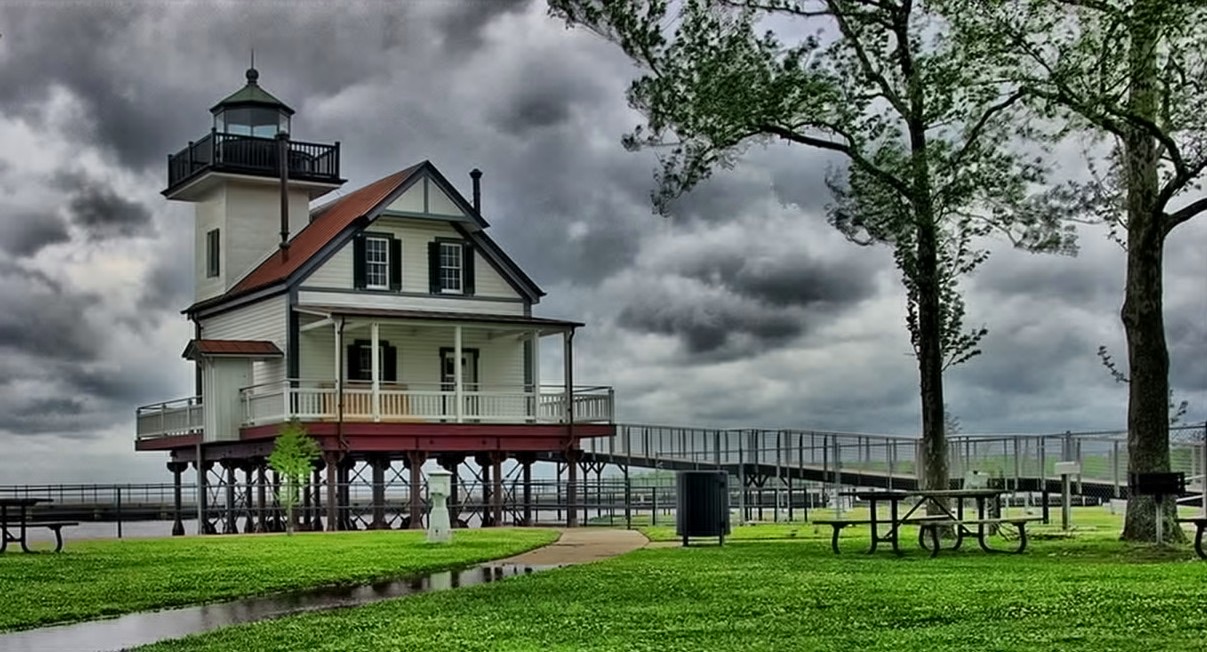
Photo: Ron Reiring / Wikimedia Commons (CC BY-SA 2.0)
Edenton, North Carolina: Where Women Told a King No
Edenton is often called the prettiest small town in the South, and it has held that claim quietly for a very long time, which is the most Edenton thing about it.
It sits on a calm bay at the head of Albemarle Sound, in the northeastern corner of North Carolina, and it is a town that history simply forgot to ruin. The waterfront is lined with homes that go back three hundred years, Georgian and Federal and Victorian, immaculately kept, looking out over the water the way they have since before the country existed. Live oaks shade the streets. A screw-pile lighthouse, one of the last of its kind, sits at the edge of the harbor. Rocking chairs wait on a porch they call the town’s front room. It is the kind of place where, the locals will tell you, people come for an afternoon and end up buying a house.
But Edenton is not just pretty. Edenton was, for a while, the center of everything.
This was North Carolina’s first colonial capital, the second-oldest town in the state, once one of its busiest ports. The men who lived here helped build a nation. One of them signed the Declaration of Independence. Another, James Iredell, was appointed by George Washington to the very first Supreme Court. For a stretch in the 1700s, this quiet bay was a hotbed of revolutionary fervor, a place where the great questions of the age were argued in parlors and on the courthouse green. The grandest building still standing is the 1767 Chowan County Courthouse, a beautiful Georgian structure that is the oldest courthouse still in active use in North Carolina, where the state Supreme Court still, on rare occasion, convenes. Walk up its brick steps and you are walking into a room where the Revolution was discussed while it was still treason to discuss it.
And then there is the teapot.
On the courthouse green stands a small bronze teapot, and it commemorates one of the bravest and least-remembered acts of the founding era. In October of 1774, a Edenton woman named Penelope Barker gathered fifty-one other women of the town, and together they signed a public resolution refusing to buy British tea or British goods until the unjust laws were repealed. It does not sound like much from here. But in 1774, women did not do this. Organized political protest by women was simply not done, and these women knew it, and they put their actual names to the document anyway, and sent it to be published in London. The British press was scandalized. They printed mocking cartoons of the “ladies of Edenton.” The women had made themselves a public spectacle on purpose, and in doing so they staged what is remembered as the first organized political action by women in American history.
That is the thing about Edenton. The biggest things happened in the smallest place.
This is not a large town. It never tried to be. Its great moments are folded quietly into a sleepy waterfront where the loudest sound is a sailboat halyard tapping a mast. The courthouse where revolutionaries plotted is the same green where children now play football. The bay that once sent ships to supply a war is now a place to launch a kayak at sunset. The town wears its enormous history lightly, almost casually, the way an old family wears its name, and you could walk the whole historic district in an afternoon and never quite realize how much of the country was shaped by people who once walked these same shaded streets.
Here is what Edenton has to teach, and it is a lesson the South knows in its bones.
Importance is not the same as size. The places where history actually happened are mostly not the big famous capitals; they are small towns like this one, where a handful of determined people did something that mattered far beyond the reach of their little bay. The women who signed that resolution were not in Philadelphia or London. They were in a tiny port town on the edge of a sound, and they changed what was possible for women in America, from there. Greatness, it turns out, does not require a grand stage. It requires courage, and a few people willing to put their names down.
Edenton has spent two and a half centuries being quietly, beautifully more important than it looks. It holds the oldest working courthouse in the state, the homes of founders, and the memory of women who told a king no, all of it gathered on a calm bay that most of the country has never heard of. Come for the prettiest small town in the South. Stay for the discovery that the smallest places have done the largest things.
The South, shared.