Photo: mana5280 / Unsplash
Staunton, Virginia: The Town That Kept Its Face
First, the name, because everyone gets it wrong the first time.
It is not Stawn-ton, and it is certainly not Stan-tun the way the map might tempt you. It is STAN-ton, with the accent up front and the middle swallowed almost entirely, and the surest way to mark yourself as being from somewhere else is to say it any other way. The people who live there will forgive you. They have heard it mangled by everyone who ever drove down from Washington or up from the coast. But say it right and you have crossed a small threshold, the way you do with Beaufort, into the company of people who know the place a little.
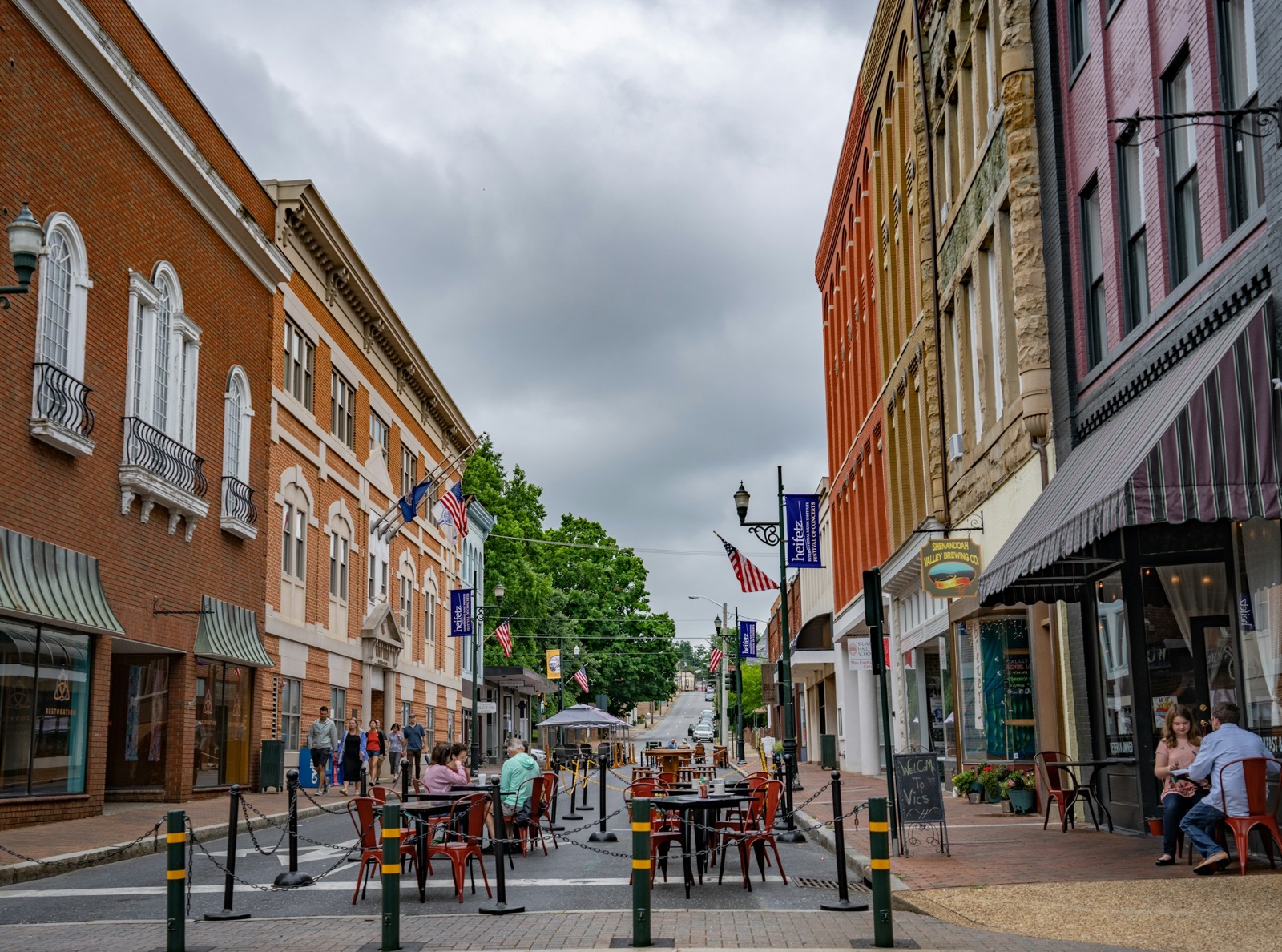
Staunton sits in the Shenandoah Valley, tucked into the folds of the Blue Ridge foothills about halfway up the western edge of Virginia, and the first thing you notice coming into it is that the town is built on hills. The streets climb and turn and give way to sudden views, and the buildings climb with them, brick storefronts stacked up the slopes so that from the right corner you can see rooflines rising in tiers like a town in a storybook. It is a compact place, a small city really, but it wears its history so densely that walking it feels like walking through a set that was never struck.
The town that decided to keep itself
Here is the thing that makes Staunton worth the drive, and it is a quiet thing, the kind of thing that does not announce itself until you have been walking a while and it dawns on you.
Almost nothing was torn down.
Most of downtown was built in the boom years between about 1870 and 1920, when the railroad turned a sleepy valley town into a thriving center of commerce, and most of it is still standing. The Beverley Historic District, the commercial heart of the town, holds one of the finest collections of Victorian architecture in Virginia, block after block of it, brick facades and cast-iron storefronts and vintage cornices, much of it wearing the same face it wore a hundred years ago. In an era when most American towns answered the arrival of the shopping mall by bulldozing their downtowns and starting over, Staunton did something rarer. It kept what it had. Beginning in earnest in the 1970s, the town threw its weight behind preservation, and the result is a downtown so intact it has stood in for other centuries in period films that needed a place that still looked the part.
Walk it and you feel the difference immediately. This is not a downtown that was gutted and then dressed up again with reproduction lampposts and a coat of nostalgia. It is the real thing, kept, and the difference between kept and revived is the difference between a face and a mask.
The man who gave it that face
Much of what you are looking at came from one man’s drawing table.
Thomas Jasper Collins arrived in Staunton in 1891 and, over the next few decades, designed or remodeled more than two hundred buildings in the city. He worked in every Victorian style there was, Romanesque and Queen Anne and Beaux Arts and half a dozen others, moving from one to the next with an ease that gave the streets their picturesque jumble, no two buildings quite alike and yet all somehow of a piece. His sons carried on the firm after him, and their work is stamped across the town so thoroughly that to walk downtown Staunton is, in a real sense, to walk through the life’s work of a single family of architects.
You can find their hand on the old railroad station, on banks and churches and warehouses, on the courthouse. It is a rare thing for a town to have a face so clearly authored, and rarer still for that face to survive intact. In Staunton it did both.
Down at the Wharf
The oldest working part of downtown grew up around the trains.
When the Virginia Central Railroad arrived in 1854, a whole district sprang up around the depot to handle the freight and house the travelers, and because the trains loaded their cargo straight into the warehouses along the tracks, the locals took to calling it the Wharf, as though the railcars were ships and the sidings were docks. In its heyday it was a rough and lively quarter of warehouses and hotels and commission merchants, streetcars pulled by mules carrying passengers up from the depot into town. Much of it burned or flooded or fell into neglect over the years, the way such districts do, but a good deal survived, and beginning in the late 1980s the town brought it back.
Today the Wharf’s brick warehouses hold coffee roasters and restaurants and shops instead of wholesale groceries, and the old freight buildings have found new lives without losing their bones. You can still stand at the end of downtown and watch the rail line run through, the tracks doing now what they have done since before the Civil War. It is one of those places where the past is not preserved behind glass but simply kept in use, which is the truest kind of preservation there is.
Shakespeare in the valley
And then there is the thing nobody expects to find in a small Virginia town.
In the middle of downtown Staunton stands the only re-creation in the world of Shakespeare’s indoor theater. The Blackfriars Playhouse opened in 2001, the home of the American Shakespeare Center, built from documentary evidence of the original London playhouse where Shakespeare’s own company performed four centuries ago. It is a working theater, not a museum piece, and it stages Shakespeare and newer work alike more than a dozen productions a year, on a stage where the actors and the audience share the same room and the same light. There is no darkened house here, no spotlight isolating the stage. The lights stay up, the way they did in Shakespeare’s day, and the effect is that you are not watching a play so much as sitting inside one.
It is an unlikely thing to find at the foot of the Blue Ridge, and that unlikeliness is part of why it works. A town that took such care to keep its own past turns out to be exactly the right place to keep someone else’s.
A few blocks from the theater sits the house where Woodrow Wilson was born, now a museum and library, one more stop for anyone who wants it. But the pull of Staunton is not any single famous address. It is the whole of the place, the accumulated weight of a town that looked at everything it had built and decided, block by block, that it was worth keeping.
Why it stays with you
You can see Staunton in a day, and you will leave already planning the next visit.
Have a coffee in a hundred-and-fifty-year-old warehouse. Walk the hills until your legs complain and the views make it worth it. Catch an evening at the Blackfriars if the season is on. But mostly just walk, and let the town do the thing it does best, which is to remind you what an American downtown looked like before we decided, most everywhere else, that the old buildings were in the way.
Staunton did not decide that. It kept its face, kept its bones, kept the hard evidence of the people who built it. And a valley town that most travelers only ever see as a name on the interstate turns out to be one of the best-preserved small cities in the South, waiting at the top of its hills for anyone willing to say its name right and climb up to see.
The South, shared.