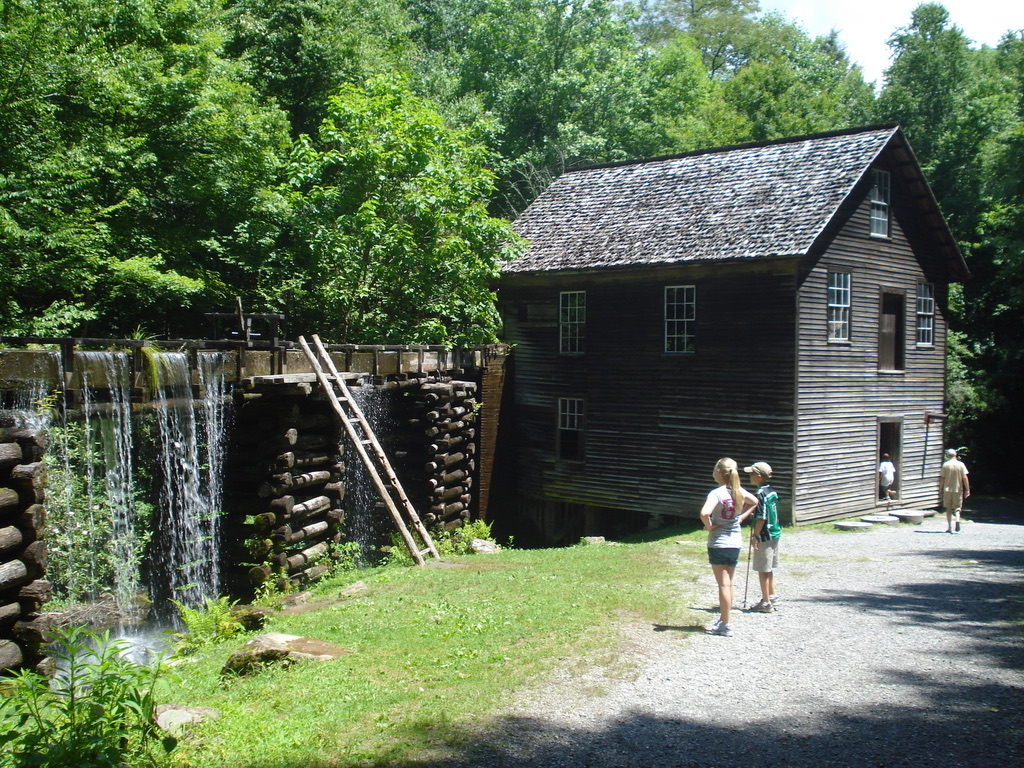
Photo: Bill McDowell
The Last of the Water-Powered Mills
The sound is the thing you do not expect. A working grist mill rumbles.
When the water gate opens and the creek pours onto the wheel, the whole building comes alive. The great wheel turns, and the shafts turn, and the gears catch, and somewhere inside the heavy stones begin to grind, and the wooden floor hums under your feet with the low rumble of it, and a fine dust of cornmeal rises into the air and settles on everything. On the floorboards. On the sifter. On the rocking chair in the corner. On the miller himself, until he is powdered pale from his cap to his shoes. It is one of the oldest machines in America, and when it runs, it feels less like a machine than like a living thing finally allowed to breathe.
The idea could not be simpler, which is why it lasted for thousands of years.
A swift creek turns a water wheel. The wheel, through a few gears, turns a heavy round stone against a second stone that does not move. Corn poured between them is crushed, finer and finer, into meal. That is the whole of it. No electricity, no engine, nothing but the weight of the stones and the patience of falling water. For most of human history this was how a community got its daily bread, and in early America every rural neighborhood had its mill, usually down on the creek, and the mill was not just where you ground your corn. It was the center of things. Often the mill was also the sawmill and the post office and the place where the whole community came together on grinding day to wait and talk.
The miller did not work for cash, because cash was scarce. He took a portion of the meal instead, a scoop off the top of every batch, the old “miller’s toll,” payment in the very thing he made.
And it was a real skill, more than it looks. The art was in the stones, in setting the gap between them exactly right. Too tight and the friction scorched the grain and ruined the flavor. Too loose and the meal came out coarse and uneven. A miller who could read his stones and his grain and his water, and keep all three in balance, was a respected man, and well paid for it, because a mill built or run badly was a fortune wasted. The men who built these mills, the millwrights, were carpenters and engineers at once, laying out gears and water channels by hand and by feel. It was knowledge held in the hands, learned by doing, passed down by working alongside someone who already knew.
And it makes something you cannot get any other way.
Anyone who has tasted truly fresh, stone-ground cornmeal or grits will tell you it is a different food from what comes in the bag at the store. Modern mills grind with steel rollers spinning at high speed, fast and efficient and a little soulless. The slow grind of heavy stones leaves the corn warmer, nuttier, fuller, the whole grain still in it. It is the difference between a tomato off the vine and a tomato in February, the difference between a fish off the hook and a fish off the truck. Stone-ground meal tastes like the corn it came from, and people who grew up on it spend the rest of their lives a little disappointed by everything else.
Almost all of these mills are gone now.
You see them as ruins along Southern creeks, a stone foundation, a rotted wheel, a historical marker where a whole community’s livelihood used to turn. The roller mill made them obsolete, and one by one the wheels stopped. But a handful still grind, scattered across the South, kept alive by people who refuse to let them stop. Some are museums now, running once a month on a Saturday with a volunteer miller narrating to wide-eyed children. A few are still real businesses, run by families four and five generations deep, the great-grandson grinding on the same stones his great-grandfather set, selling sacks of meal and grits to anyone who comes by and to a few restaurants that know the difference.
This is not really a story about cornmeal.
It is a story about a kind of knowledge so old we forget it was ever knowledge at all. We turn a tap, we buy a bag, and we never think about the falling water and the turning stone and the powdered miller reading the gap with his fingers. A working mill remembers all of that for us. It is a whole vanished world still turning on a creek, the engineering and the patience and the taste of food made slowly, and when the last wheel finally stops, we will not just lose a way to grind corn. We will lose a way of understanding where our daily bread comes from.
Some things are worth keeping not because we need them anymore, but because they hold a truth we are in danger of forgetting. The water-powered mill is one of those things. It still turns, in a few places, rumbling and dusty and slow, grinding out meal that tastes like the South used to taste, powered by nothing but a creek that has been falling the same way since long before any of us, and will go on falling after.
The South, shared.
Keep Reading
Southern Stories
The Front Porch, Part Two: On the Art of Sitting a SpellWe wrote once about why the South built porches. This is about what people did on them: the lost art of sitting, watching, and letting the evening pass.
Southern Stories
The Courthouse Square, and the Town That Grew Around ItIn a thousand Southern towns, everything points to the same place: the courthouse on the square. Here is why it was built that way, and why it still holds.
Southern Stories
The Last of the Whole-Hog PitmastersCooking a whole pig over wood coals from dark to dawn is one of the oldest crafts in the South, and one of the fastest disappearing.